Backflow testing for irrigation and landscape systems
An irrigation line is a cross-connection to soil, fertiliser and standing water. On any ICI or multi-residential property in Durham, the backflow preventer on that line is on the Region's record and tested every year. Because the system is drained over winter, the test happens at spring start-up.
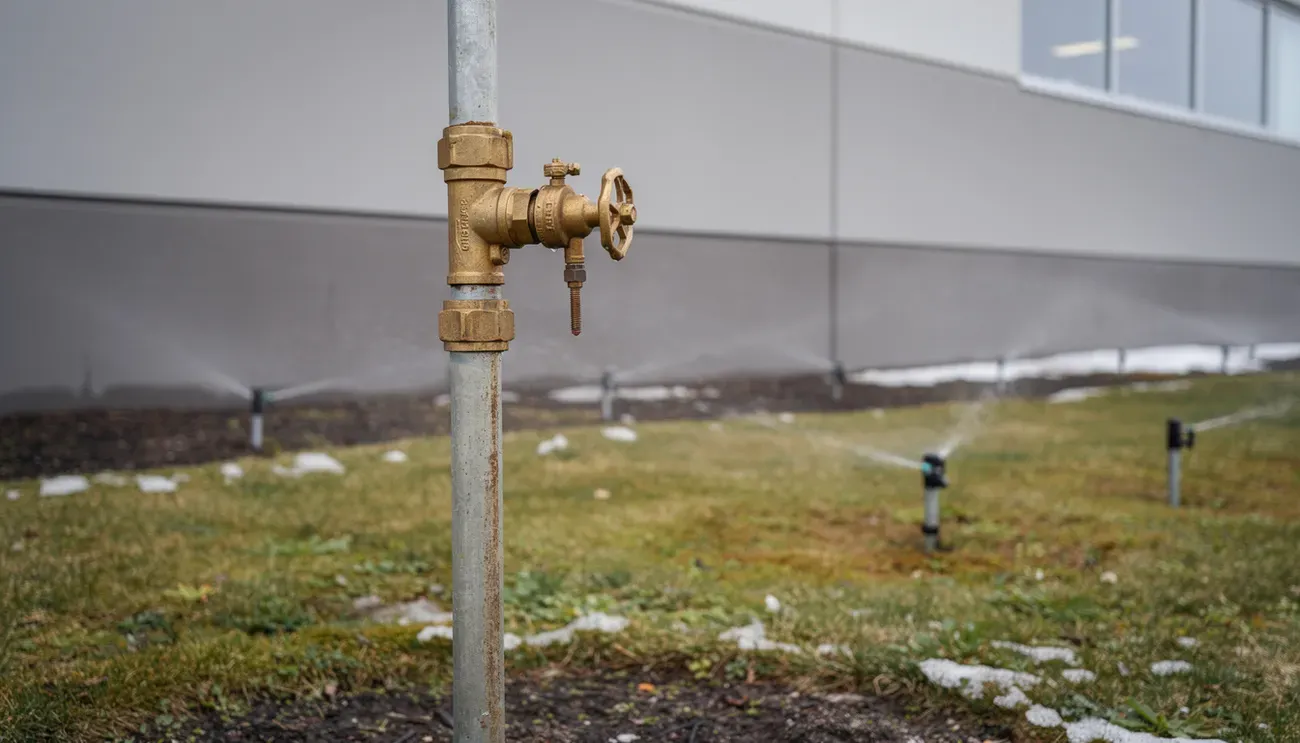
Why irrigation is on the Region’s list
An irrigation system connects the drinking water supply to sprinkler heads sitting in soil, standing water after rain, lawn treatments and, on some systems, fertiliser injection. If pressure in the main drops, that mix can be pulled backward. That is a cross-connection under the by-law’s definition (section 1.1(k)), and on any industrial, commercial, institutional or multi-residential property in Durham it is protected by a backflow preventer that the Region has on record and that must be tested every year (section 6.3).
Property managers are often surprised the irrigation device is on the list at all. It sits outside, it is only live half the year, and it was installed by the landscape contractor rather than the plumber. It is on the list.
Which device is on your irrigation line
| Device | When it is used | Where it must be |
|---|---|---|
| PVB (pressure vacuum breaker) | The common choice: backsiphonage protection, no chemical injection | Above the highest sprinkler head, typically by 300 mm, outdoors near the controller or where the line exits the building |
| DCVA (double check) | Where the layout does not allow a PVB above all heads, or backpressure is possible, moderate hazard | Can be in a below-grade box because it does not discharge |
| RPZ (reduced pressure) | Irrigation with fertiliser or chemical injection, or where the property has an auxiliary supply | Above ground with drainage, never in a pit |
Each is tested to CSA B64.10.1. The PVB page has the diagram, what the test checks, and the failure modes.
Spring start-up is the test window
Irrigation devices are winterised in fall (water drained, lines blown out) and cannot be tested until the system is pressurised. That makes the week of spring start-up the natural moment: the irrigation contractor turns the system on, and the backflow test happens the same week. It catches freeze cracks and stuck air inlets before the first watering, and gets the report to BSI Online early in the season.
We plan spring irrigation runs by area across Durham so a property manager with sites in three municipalities has them all done in the same week. If your notice’s due date does not line up with your start-up, tell us; pressurising one zone early for the test is usually possible.
Working with your irrigation contractor
Two ways this goes:
- The contractor is a registered tester. Appendix A of the by-law allows lawn irrigation installers with a tester’s licence to test irrigation devices. If yours is registered, they can test at start-up and file. Ask to see the filing confirmation.
- The contractor is not a registered tester. More common. They start the system up; we test the device the same week and file. We coordinate directly with the contractor so nobody has to be there twice.
Either way, a device that fails at start-up (stuck air inlet, cracked bonnet) is repaired by the contractor’s plumber or a licensed plumber and retested. Section 6.4 of the by-law requires the Region to be notified within 24 hours; the tester does that.
Common irrigation failures
- Air inlet stuck shut after a winter of sitting idle. The most common PVB failure by far.
- Freeze damage where the device was not fully drained.
- Leaking check or air inlet, spraying at start-up and holding below minimum.
- Installed too low: a PVB below the highest head is an installation error, not a test failure, but the Region can require it be corrected.
More on the failed test page and in why backflow preventers fail.
Records and the notice cycle
The irrigation device has its own record at the Region and its own notice. Because it is seasonal, its anniversary tends to fall in spring or early summer. Keep the report with the property’s other compliance records for five years (section 6.6). We remind you 30 days before the next due date, which for irrigation means a reminder in late winter to book the start-up test.
Irrigation and landscape: questions
When is the right time to test an irrigation backflow preventer?
At spring start-up, once the system is pressurised, before the first watering cycle. Winter is impossible (the line is drained) and mid-summer means the report is late against a spring due date. If your notice has a due date before your normal start-up, tell us; it can make sense to pressurise that zone early for the test.
Can our irrigation contractor test it?
If they hold a tester's licence and are registered with the Region. Appendix A of the by-law specifically allows lawn irrigation installers with a tester's licence to test irrigation devices. Many good irrigation contractors are not registered testers, in which case they do the start-up and we do the test the same week.
Do residential lawn systems in Durham need testing?
The by-law applies to ICI and multi-residential properties. A single-family home is outside it. Irrigation on a condo corporation's grounds, a plaza, a school field, a church lawn or a business park is inside it. If you received a notice, you are inside it.
Our device is a double check, not a PVB. Is that wrong?
Not necessarily. A PVB only protects against backsiphonage and must be above the highest sprinkler head. Where the layout does not allow that, or where backpressure is possible, a DCVA is used for moderate hazard. Irrigation with fertiliser or chemical injection needs an RPZ. All three are tested annually.
Add the test to your spring start-up
Tell us the property, your irrigation contractor, and your usual start-up week. We schedule the test to land the same week and file the report before the due date.