Why Backflow Preventers Fail (and Why Hard Water Makes It Worse)
The failure modes behind most failed tests: fouled checks, worn rubber, weak springs, stuck air inlets, weeping relief valves, freeze damage. Which devices get which, and what scale does.
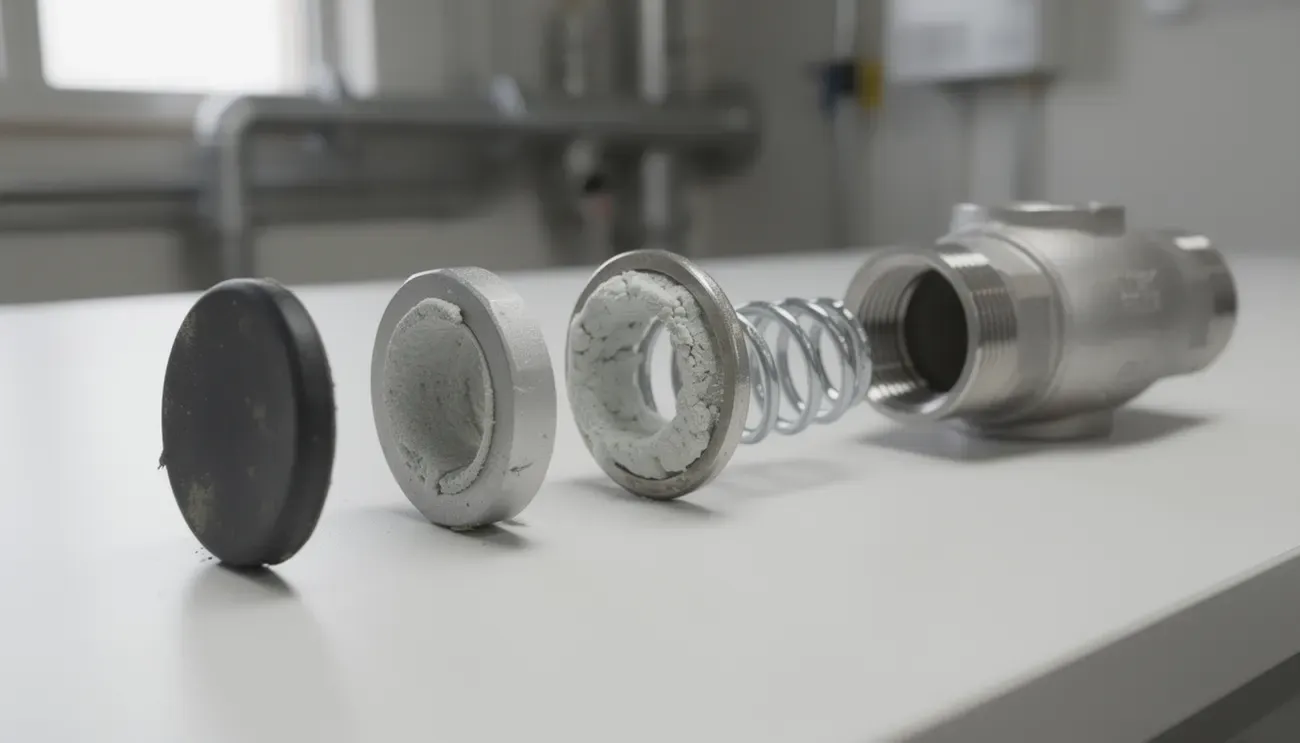
A backflow preventer is a spring, a rubber disc, and a seat, repeated two or three times inside a brass body, sitting in flowing water for years. It fails the way anything like that fails: something wears, something sticks, something cracks. Here is the list, in roughly the order it turns up on failed reports.
Fouled checks
The most common single cause. A check valve holds because a rubber disc seats cleanly on a metal or plastic seat. Grit, sediment, rust flakes or mineral scale on either surface, and it does not seat. The differential across the check drops below the CSA B64.10.1 minimum and the component fails.
Where the debris comes from: watermain breaks and repairs nearby (a slug of sediment moves down the line), construction, old galvanised piping upstream, and, over the long run, scale.
Sometimes a flush clears it. More often the disc is scored by the debris and needs replacing. A rebuild kit and a licensed plumber.
Worn rubber
Discs, seats and O-rings harden, crack and take a set over years of cycling and chlorinated water. A hardened disc does not conform to the seat; a cracked O-ring leaks past. Slow, predictable, and the reason a device that passed comfortably five years ago passes marginally now and fails next year. A tester who tells you “check 1 is marginal” is describing this. Rebuild kit.
Weak or broken springs
The spring pushes the disc onto the seat with a set force, which is what produces the differential pressure the test measures. Springs fatigue and corrode. A weak spring holds below minimum; a broken one holds nothing. Rebuild kit.
Relief valve trouble (RPZ only)
The relief valve is what makes an RPZ an RPZ. Two failure modes, opposite in character:
- It discharges constantly. The relief valve opens when the pressure between the checks gets too close to supply pressure. Almost always this means the first check is fouled or worn and letting pressure through. Sometimes debris under the relief valve seat. The device is doing what it should: telling you the first check is bad. It will not pass in that state, and it wastes water in the meantime.
- It does not open when it should. A stuck diaphragm, a blocked sensing passage, scale in the relief valve. This is the dangerous one, because it silently removes the fail-safe. The test catches it (the relief valve opening point is the first thing measured on an RPZ) and it is a rebuild.
Stuck air inlet (PVB only)
The air inlet on a pressure vacuum breaker sits shut under pressure all season, then sits dry all winter. Debris, insects, or a seal that has dried in place keep the poppet from lifting when the test bleeds pressure down. The most common irrigation failure by a distance, and why the first test at spring start-up is where irrigation devices fail. Cleaning or a rebuild kit.
Freeze damage
Water left in a device over winter cracks bonnets and bodies. Irrigation devices that were not fully drained; RPZs and DCVAs in unheated rooms, pits, or exterior enclosures with failed heat tape. Visible on the first pressurisation as a spray or a wet floor. Usually a replacement, occasionally a bonnet.
Shut-off valves that will not hold
Not a failure of the assembly itself, but the test cannot be completed if the tester cannot isolate it. Old gate valves that have not been turned in years are the culprit; they either will not close or will not seal. A plumber frees or replaces them, and then the assembly can be tested. In older Durham buildings this comes up more than people expect.
Installation problems that surface at test time
An RPZ in a pit that floods, so the relief valve is submerged. A PVB installed below the highest sprinkler head. A device with no drain under it, so the relief valve discharge goes on the floor. None of these are test failures on the day, but the tester notes them, and the Region can require correction. Plumbing work.
What hard water does to all of the above
Water hardness is dissolved calcium and magnesium. As water passes through the tight clearances inside a backflow assembly, and especially where it sits still between uses, minerals precipitate as scale on seats, discs, springs and the relief valve’s sensing passages. Scale on a seat is a fouled check; scale on a spring changes its rate; scale in a relief valve passage is a relief valve that opens late.
Durham’s water comes from three kinds of source, all Regional: Lake Ontario plants for the lakeshore municipalities, a Lake Simcoe plant for Beaverton, and groundwater wells for Uxbridge, Port Perry, Cannington, Sunderland, Blackstock, Greenbank and Orono. Groundwater is typically harder than lake water. We are not going to quote a hardness figure here because we have not verified one for each system; the Region publishes an annual water quality report per system with the measured value. What we can say from how devices fail is that on harder water, discs and seats foul sooner, springs age faster, and a “marginal” note on a test is a stronger signal to budget for a rebuild before the next cycle.
Buildings that heat water hard (boilers, dish machines) accelerate the same process on the devices serving those lines, which is part of why kitchen and boiler RPZs fail more often than an office double check.
The by-law’s view of a failure
Section 6.3 requires the device to be maintained and tested annually. Section 6.4 says what happens when the test shows it is not in proper working condition: the tester notifies the Region and area municipality within 24 hours, and repairs or replacement proceed immediately at the owner’s expense. Repairs are done by a licensed plumber (Appendix A). Then a retest and a passing report. Our failed test page walks through it.
Reading the signs before the test does
- An RPZ relief valve that spits when nothing is running.
- A PVB that sprays at spring start-up and does not stop.
- A wet floor or a stained wall under the device.
- Shut-offs that resist turning.
- Last year’s report with a marginal reading on any component.
Any of those and the honest advice is to book a look, or at least budget for a rebuild at the next test, rather than wait for the failed report and the 24-hour clock.
Questions this raises
How often do backflow preventers fail their annual test?
It varies with device type, age, water and use. RPZs on hard-working lines (kitchens, boilers) fail more often than a double check on an office domestic service; irrigation PVBs fail most often on the first spring test. We do not quote a percentage because we do not have a verified Durham figure; ask the tester what they see.
Can a failed device be repaired, or does it have to be replaced?
Usually repaired. Rebuild kits (discs, seats, springs, O-rings, relief valve parts) fix most failures. Replacement is for cracked bodies, obsolete models with no parts, or a device the survey found to be the wrong type for the hazard.
Is there anything I can do between tests to prevent failure?
Keep the device accessible and visible, do not let anyone plug a discharging relief valve, winterise irrigation properly, exercise the shut-off valves occasionally, and act on a tester's note that a check is marginal. Beyond that, the annual test is the maintenance.