How to Find Your Backflow Preventer (and Tell Which Type You Have)
Where the device usually is in a Durham commercial or multi-residential building, what it looks like, how to read the plate and tag, and how to tell a DCVA from an RPZ from a PVB.
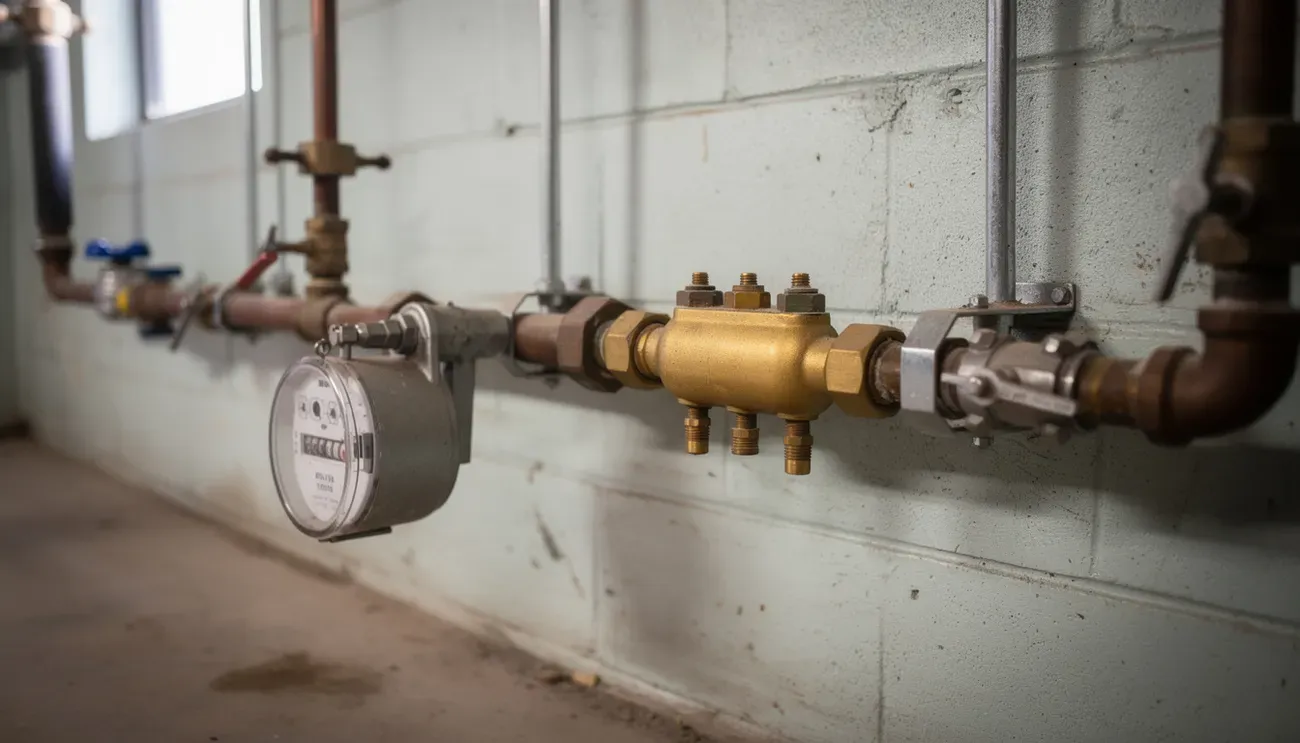
The notice names a device. Before you can book a test you need to know where it is, and it helps to know what it is. This is a walk through the building with that in mind, and it applies to any Durham municipality because the by-law and the devices are the same everywhere.
Where to look first
The device on the Region’s notice is almost always the premise isolation assembly (by-law section 1.1(y)): the one on the water service where it enters the building, protecting the municipal main from everything inside. So start where the water comes in.
| Building type | Most likely location |
|---|---|
| Apartment or condo | Mechanical room or meter room in the basement or at grade, right after the water meter |
| Office, plaza, retail | Utility or sprinkler room near the front or side of the building, near the meter |
| Restaurant | Back room, basement, or a utility closet; sometimes in the plaza’s shared meter room if the restaurant is a tenant |
| Industrial | Main mechanical room near the service entrance; other devices scattered on process lines |
| School, church, community centre | Boiler room or main mechanical room |
| Irrigation | Outside, near the irrigation controller or where the line leaves the building; a PVB stands upright, a DCVA may be in a below-grade box with a green or black lid |
Follow the pipe from the meter. The assembly is downstream of the meter, usually within a few metres.
What it looks like
A testable backflow assembly is a length of brass or bronze (sometimes painted, sometimes plastic-bodied on small sizes) with:
- A shut-off valve at each end, ball or gate.
- Small valves with square heads along the body, usually four on a DCVA or RPZ, two on a PVB. These are the test cocks. If a device has no test cocks it is not a testable assembly and it is not what the notice is about.
- A manufacturer’s plate or casting with the make (Watts, Febco, Zurn Wilkins, Apollo, Ames and others), model, and size, and usually a serial number.
- A tag, if it has been tested before, wired to the body or hung beside it.
Telling the three types apart
| Type | Shape | Give-away |
|---|---|---|
| DCVA (double check valve assembly) | Two check bodies in a row, horizontal, four test cocks | No drain port, no relief valve underneath. Can be in a pit or box because it never discharges. |
| RPZ (reduced pressure principle assembly) | Two check bodies in a row with a third body hanging underneath between them, four test cocks | A relief valve on the bottom with an open discharge port, usually over a floor drain or with an air gap fitting. Never in a pit; must be able to drain. |
| PVB (pressure vacuum breaker) | A single upright body with a canopy or bonnet on top, two test cocks | Stands vertical, installed above the highest sprinkler head, almost always on irrigation. |
Our device pages have labelled diagrams: DCVA, RPZ, PVB.
Fire sprinkler lines have their own variants (a DCVA or RPZ with a small bypass meter, called a DCDA or RPDA). Those are on the fire protection system and are tested by personnel approved by the Commissioner under section 9.1; they are not the domestic device on your notice.
Reading the tag
The by-law (section 6.10) says the tag must show: property address, device location, type, manufacturer, serial number and size, test date, the tester’s initials, the tester’s name or their employer, and the tester’s licence number. So the tag tells you:
- When it was last tested. Within a year: a test may already be done (check whether it was filed). Older: due.
- Who tested it. Useful if you want the same person, or want to ask them for the filing confirmation.
- The serial number, which should match the notice.
Our post on what the tag means goes deeper.
Matching the device to the notice
The notice carries the Region’s record: type, make, model, serial, size, location. Compare it to the plate and the tag. Three outcomes:
- Everything matches. Book the test.
- Serial or model differs. The device was replaced and the record was not updated, or the serial was transcribed wrong. Tell the tester; the report can correct the record.
- You cannot find anything matching. Either the device is somewhere unexpected (an old boiler room, a locked closet, a pit outside), or the record is wrong. Send us the notice and a photo of what you did find; the Region’s record often has a location note.
More than one device
Many buildings have several. A condo tower: a DCVA on domestic and an RPZ on boiler make-up. A plaza: the landlord’s premise device plus tenant devices in the restaurant and the salon. An industrial site: half a dozen on process lines. Each is on the Region’s record and each has its own notice and its own annual test. When you find one, ask whether there are others; the survey report, if the building has a copy, lists them all.
What to do once you have found it
Clear a metre around it, check that the shut-off valves are reachable and turn, note the location precisely (“basement mechanical room, north wall, behind the water meter”), and book the test. If you want it arranged, the quote form asks for exactly those details.
Questions this raises
The device has no small valves on it. Is it still a backflow preventer?
It may be a non-testable device (a dual check or a hose bibb vacuum breaker). Those have no test cocks and are not what the Region's test notice is about. Keep looking for an assembly with test cocks on the incoming service, usually near the meter.
There are two devices in a row. Which one is on the notice?
Compare serial numbers. The notice names the device the Region has on record, with its make, model and serial. If both are testable assemblies, both are probably on record and both are due; the notice may list them separately.
The device is in a locked room and I do not have a key. What now?
Find who does before booking. Superintendent, landlord, facilities, the last plumber. Section 7.1 of the by-law requires owners to provide access for inspection on reasonable notice, and nothing slows a test down like a locked door.